
Module 1 of 3
How to Start Trading
This module is about where to start, before you put any money in. It's five video lessons, each with study notes, a quiz and a reflection worksheet, and you can watch Lesson 1 free further down this page.
Free lesson
Lesson 1: Instruments
Lesson 1 puts stocks, ETFs, options, futures, forex and crypto through the same five questions. It's free, and you don't need to sign up to watch it.
Before you watch
Futures losses can exceed your deposit. When the S&P 500 moves 1% in a day, one Micro E-mini S&P 500 contract (MES) gains or loses about $375.
Contract values move with the index. One MES is worth $5 times the S&P 500, so with the index near 7,500 (July 2026) it represents about $37,500.
Near the end, the "my recommendation" line and the three trader profiles show the five questions in use. They're general examples, not recommendations for you.
Read the transcript
This is everything the narrator says in Lesson 1, in order. The voice is AI-generated, reading our script, and the notes in square brackets are ours rather than part of the video.
Module 1, Focus 1: Instruments, What You Can Actually Trade.
Disclaimer. This content is for educational purposes only. It is not financial, investment or tax advice. Trading carries substantial risk of loss, including the risk of losing more than you invest. Past performance does not predict future results. Consult licensed professionals for advice specific to your situation.
Let's begin! Most people pick what to trade by accident. They watch a video about options, so they trade options. A friend mentions futures, so they open a futures account. Someone online made money on a small-cap stock, so they go hunting for the next one. That's copying. It isn't a decision.
What you trade has to fit your life, your capital, the hours you can be at the screen, the speed you can keep up with. This focus is about making that decision well. We'll look at the main instruments retail traders use (stocks, ETFs, options, futures, forex and crypto) and run each one through five questions that tell you whether it fits you. By the end, you'll know which one to start with.
Why this matters
Three quick examples of what choosing wrong looks like.
First, someone with $2,000 opens an options account because options promise big returns. They lose half of it in three weeks because options are time-sensitive and they didn't account for that. The strategy didn't fail. The instrument didn't fit.
Second, someone with a full-time job picks day trading because the videos make it look exciting. They miss the open every morning. They miss the close every afternoon. They take trades on their phone during meetings and lose money. The strategy didn't fail. The schedule didn't fit.
Third, someone wants to invest for the long term and starts buying penny stocks because they're cheap. They get caught in pump-and-dumps and quit within six months. The strategy didn't fail. The instrument was wrong for the goal.
Three different people, three different mistakes, same root cause. They picked the instrument before they thought about themselves. So we're going to flip that. Five questions about you first. Then we look at the instruments.
The five-question lens
Five questions. Use them on every instrument we cover today and every instrument you encounter later.
Question one, capital. How much money do you actually need to start? Not the minimum to open the account. The minimum to trade in a way that makes sense.
Question two, leverage. Does the instrument come with built-in leverage? Leverage means a small price move turns into a big account move. That works in both directions.
Question three, time. What hours does this instrument trade, and can you actually be there? An instrument that moves while you're at work is a different instrument than one that moves at night.
Question four, speed. How fast does the instrument move? Can a human follow it, or are you competing with machines that act in milliseconds?
Question five, hidden costs. What are you paying that isn't on the front page? Spreads, commissions, market data fees, financing costs, contract rollovers. The advertised cost and the real cost are usually different.
Capital, leverage, time, speed, hidden costs: five questions. Run every instrument through them.
Stocks and ETFs
Stocks first. A stock is a share of a company. You buy it, you own a piece of the business. If the business does well over time, the share price tends to follow. An ETF is a basket of stocks bundled into one ticker. Instead of buying 30 companies one at a time, you buy one ETF that holds all 30 for you. Now run the five questions.
Capital. You can start with whatever you have. Many brokers now offer fractional shares, so $100 buys you a slice of an expensive stock. The question isn't whether you can start. It's whether the amount you can start with leaves room to actually learn without one bad week wiping you out.
Leverage. Stocks don't come with built-in leverage. You can add leverage by trading on margin, but you have to opt in. By default, if you put in $1,000, your maximum loss is $1,000.
Time. US stocks trade from 9:30 in the morning to 4 in the afternoon, Eastern time, five days a week. There's pre-market and after-hours, but liquidity thins out outside regular hours. We'll cover that more in Focus 3.
Speed. Most stocks move at a pace a human can follow. The exceptions are penny stocks, biotech announcements, and meme stocks during a pump. Those move at machine speed, and we'll talk about that in Module 2.
Hidden costs. Most major brokers in the US and Canada offer commission-free stock trading now. The hidden cost is the spread, the difference between the buy price and the sell price, which is small for liquid stocks and meaningful for thinly traded ones.
Stocks and ETFs are where most people should start. Lowest barrier, slowest pace, most forgiving structure. The trade-off is that returns are smaller per dollar than leveraged instruments. You trade speed of growth for room to learn.
Options
Options are contracts. A call option gives you the right to buy a stock at a fixed price by a fixed date. A put option gives you the right to sell a stock at a fixed price by a fixed date. That's the textbook definition.
Here's what actually matters for this focus. Options give you exposure to a stock for a fraction of the cost of buying the stock. That's the appeal. They also expire, which means you can be right about the direction and still lose money if you're wrong about the timing. Now the five questions.
Capital. You can buy a single options contract for under $100 in many cases. The barrier to entry is low. The barrier to doing it well is high.
Leverage. Built in. One options contract typically controls 100 shares of stock. You're not borrowing money, but you're getting leveraged exposure through the structure of the contract itself. A small move in the stock can mean a large move in the option price, or it can mean the option goes to zero.
Time. Options trade during the same hours as the underlying stock, but options have a clock running. Every day that passes, an option loses a little value, even if the stock doesn't move. That's called time decay, and it's the single biggest reason new options traders lose money.
Speed. Options move fast. A 2% move in the stock can mean a 30% move in the option. That sounds great until it goes the other way.
Hidden costs. Options have wider spreads than stocks. Commissions are usually charged per contract, and there's the hidden cost of complexity. There are five or six variables that affect an option's price, and if you don't understand them, you're not trading options. You're guessing.
Options are a real tool: hedging a stock portfolio, generating income on shares you already own, taking defined-risk positions. But they reward people who study them and punish people who don't. We cover them in detail in Module 2.
Futures
Futures are contracts to buy or sell an asset at a future date for a price agreed today. Most retail futures traders never take physical delivery. They close the position before expiration. What futures actually are, in practice, is a way to trade indexes, commodities, and currencies with built-in leverage and tight spreads.
The most important thing to know is that futures come in two sizes, standard contracts and micro contracts. A standard E-mini S&P 500 contract, the ES, has a multiplier of $50 per point. A Micro E-mini S&P 500, the MES, has a multiplier of $5 per point. One-tenth the size. Same market, same hours, 10 times smaller exposure. Now the five questions.
Capital. You can open a futures account at most active-trader brokers with around $500 and trade micro contracts immediately. Day-trade margins on micro contracts are often $50 to $100 per contract. That's per contract, meaning the broker lets you control a position with that much capital posted. We'll cover the difference between day-trade margin and overnight margin in Module 2, and that distinction matters.
Leverage. Built in, and significant. A single MES contract gives you exposure to roughly $50,000 of S&P 500 index, depending on where the index is trading. That's leverage by structure, not by choice.
[Our note: one MES is worth $5 times the S&P 500. With the index near 7,500 (July 2026), that's about $37,500, and an ordinary 1% day moves it about $375. Futures losses can exceed your deposit.]
Time. Futures trade nearly 24 hours a day, 5 days a week. That sounds great if you have a day job. And for some sessions, it is. But not all hours are equal. Volume concentrates around the regular US session. Off-hours trade thinner and can move sharply on overnight news. Focus 3 covers this in detail.
Speed. Index futures move fast. The S&P 500 can travel its daily range in 15 minutes when there's news. But you can also use larger time frames: hourly, 4-hour, daily. And trade futures the same way you'd trade stocks.
Hidden costs. Commissions are small, usually under $1 per side at active-trader brokers. Spreads on the major contracts are tight. The two costs that surprise people are market data fees, which we cover in Focus 2, and contract rollover, which we cover in Module 2.
My recommendation for understanding day trading specifically is to start with micro futures on a major index. Low capital, tight spreads, liquid markets. Real leverage so the lessons stick. We go deep on this in Module 2.
[Our note: this line, like the three profiles further down, shows the five questions in use. It's a general example, not a recommendation for you.]
Forex
Forex is foreign exchange, trading one currency against another. Euro against US dollar. US dollar against Japanese yen. It's the largest market in the world by volume, and it runs 24 hours a day, 5 days a week, across four major sessions. The five questions.
Capital. Forex has the lowest barrier to entry of any instrument we'll cover. Some brokers let you open an account for a single dollar. Most regulated retail forex brokers want $100 or so to start. The low barrier is genuine, but it can also be a trap. Small accounts with high leverage are how people lose everything quickly.
Leverage. The highest of any instrument here. Retail forex leverage in the US is capped at 50 to 1 on majors. In other countries it can run hundreds to one. That kind of leverage means a small move in your favour is a big win, and a small move against you is a wipeout.
Time. The 24-hour structure is real. There are four sessions: Sydney, Tokyo, London, New York. And they overlap. The London–New York overlap, roughly 8 in the morning to noon Eastern time, is when the major pairs move most. Off-hours, things slow down.
Speed. Major pairs move at a moderate pace most of the time. They can spike around economic news (central bank decisions, inflation reports, employment numbers), and those spikes are fast.
Hidden costs. Spreads are the main cost in forex, and they widen during off-hours and around news. Some brokers also charge swap fees for holding positions overnight. The biggest hidden cost is the broker model. Many forex brokers are market makers, meaning they take the other side of your trade. That's not necessarily bad, but it changes the relationship and is worth understanding.
Forex is accessible, but the leverage makes it harder to learn safely than it looks. We cover it where relevant in later modules.
Crypto
Crypto sits in its own category. 24/7 trading. No central exchange. Wide variation in regulation depending on where you live. And the spread between the major coins and everything else is enormous. Bitcoin and Ethereum behave like real markets, and most of the rest behave like penny stocks. Through the five questions, briefly.
Capital. Low. You can buy a few dollars of any major coin.
Leverage. Available on some platforms, often very high, often in jurisdictions with weak oversight. On most regulated exchanges in the US and Canada, spot crypto has no leverage.
Time. 24/7. That sounds like a feature. For most people, it's a problem. There's no closing bell to make you stop.
Speed. Major coins move at a pace similar to stocks. Smaller coins move at penny-stock speed and worse.
Hidden costs. Exchange fees vary widely. Network fees on the underlying blockchain. Spread costs on lower-volume coins. And depending on your country, tax treatment can be complex.
Crypto isn't the focus of this course. If you want to trade it, the same five questions apply. We'll touch on it where it's directly relevant, but the bulk of what we'll teach is in stocks, ETFs, options, and futures.
The fit framework
Now we put it together. The five questions tell you the shape of each instrument. The fit framework tells you which shape matches your shape. Three honest profiles.
Profile one. Full-time job. Limited capital. Wants to learn without losing the money quickly. Best fit: stocks and ETFs on swing or position time frames. You're not trying to compete on speed. You're trying to learn the markets while protecting your capital.
Profile two. Some flexibility during the day. Comfortable with technical learning. Wants to understand short-term price action. Best fit: micro futures on a major index. Real leverage. Tight spreads. Low capital requirement. And the day-trading skill set transfers to other instruments later.
Profile three. Already owns stocks long-term. Wants to generate income or hedge against downside. Best fit: options on the stocks already owned. Specifically, covered calls and protective puts. The two strategies designed for people who already hold shares.
These aren't the only profiles. They're the three that come up most often. The point isn't to fit yourself into one of them. It's to see how the five questions plus your real situation produce a real answer. Forex and crypto can fit in too. They just require a clearer eye about leverage and hours than most people walk in with at the start.
Before we close
One honest note before we close. The five questions don't tell you which instrument is best. There isn't one. They tell you which instruments are reasonable starting points for someone in your situation. And which ones to leave alone until something changes. More capital. More flexible hours. More study.
And the question of what to trade is only half the decision. The other half is where you trade it. Two traders trading the same instrument at the same time on different brokerages can have completely different costs and completely different tools available to them. That's Focus 2. Brokerages: where you trade and why it matters more than most people think.
Five lessons, in order
Every lesson comes with study notes, a quiz with an answer key, and a reflection worksheet.
-
Lesson 01
Instruments: What You Can Actually TradeFree
Six instruments, from stocks to crypto, measured against the same five questions about capital, leverage, trading hours, speed and the costs that never make it into the advertised price.
-
Lesson 02
Brokerages: Where You Trade, and Why It Matters
How brokers differ in who regulates them, what they really charge, what market data costs and which instruments they offer, and which platform features start to matter once you trade more often.
-
Lesson 03
Market Hours & Sessions: Finding Your Time in the Market
The US trading day and the global sessions, all in Eastern Time, and why the hours you can spend at a screen decide which styles of trading are open to you.
-
Lesson 04
Time Frames: From the Long View Down to the Minute
Four trading styles compared on how much screen time and capital they take, how quickly they make you decide, and what each one asks of your day.
-
Lesson 05
Realistic Expectations: Market Tuition & the Long View
What three studies of active traders in Brazil, Taiwan and the US found, and what the first three months and the first year usually look like.
What comes with each lesson
Each one is a separate PDF, so you can print only what you need, or download all three files for a lesson at once.
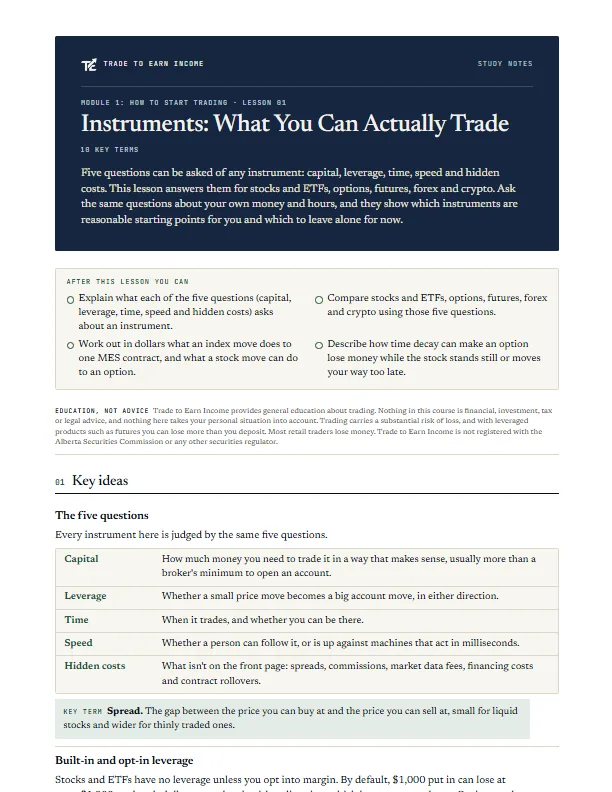
Study notes
The lesson's key ideas, with worked examples and comparison tables. Every figure shows its source and the date it was checked.
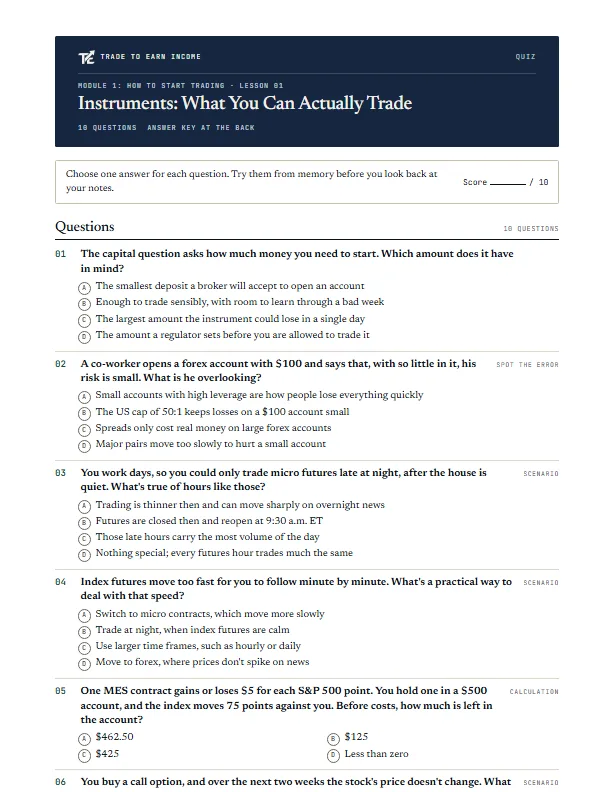
Quiz and answer key
Ten questions, some of them scenarios or calculations. The answer key explains each answer, including why the tempting wrong ones are wrong.
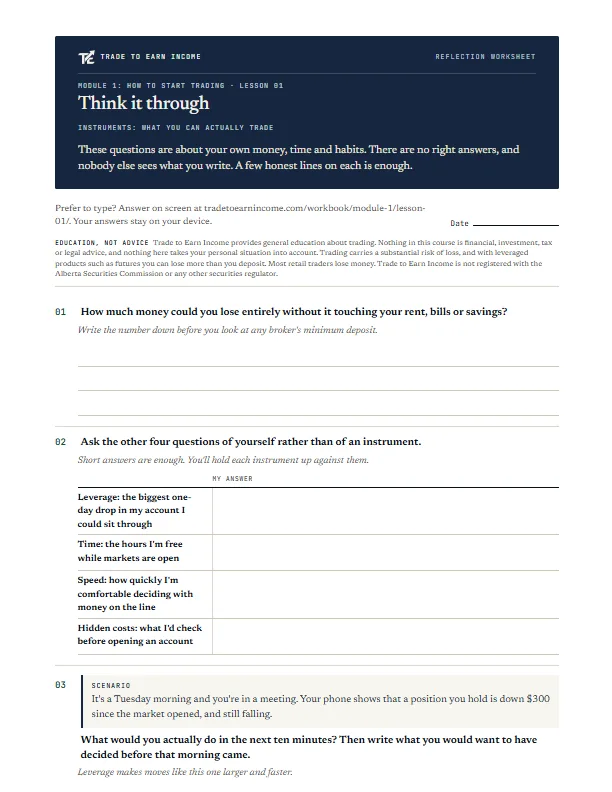
Reflection worksheet
You can print it or answer on your phone, and your answers stay on your own device.
Five questions for any market
Lesson 1 puts them to six instruments, and the later lessons keep coming back to them.
-
Capital
How much money do you need to trade it sensibly? It's usually more than the minimum a broker asks for to open an account.
-
Leverage
Is leverage built into it? Leverage turns a small price move into a large change in your account, and the same thing happens when the price goes against you.
-
Time
When does it trade, and can you be there? A market that moves while you're at work behaves differently from one that moves in the evening.
-
Speed
How fast does the price move? Some markets give you minutes to decide, and others give you seconds.
-
Hidden costs
What are you paying that isn't on the front page? Spreads, commissions, data fees, financing and rollovers are the usual ones, which is why the advertised cost and the real cost are usually different.
Who Module 1 is for
A good fit if
- You're new to trading, or you've dabbled and want to start properly.
- You've watched hours of trading videos and still don't know where to begin.
- You'd rather have the risks stated plainly.
Not a fit if
- You want a strategy to copy, or signals telling you what to trade.
- You're hoping to replace your income this year.
- You've traded for years and want advanced material.
Module 1
$29USD, once
That's about what a week of coffee costs. People who learn the same basics through losing trades usually pay far more, in money and in years of their time.
- Five lessons with captions
- Study notes, a quiz with an answer key and a reflection worksheet for each lesson
- Watch in any browser, at your own pace
- Lesson 1 free to watch before you buy
For adults. All sales are final; see the Refund Policy. By buying, you agree to the Terms of Service and confirm you've read the Risk Disclosure. Sales tax is added at checkout where it applies. Checkout by Payhip; cards are processed by Stripe, so we never see your card number.
About Module 1
Do I need experience or a brokerage account?
You don't need either. Lesson 1 starts with what each instrument is, and nothing in the module asks you to open an account or place a trade.
Why pay when YouTube is free?
There are plenty of good trading clips on YouTube, but they rarely come in an order that builds from one to the next. These five lessons do, because each one picks up a question the lesson before it raised, and the notes, quizzes and worksheets were written to go with them.
What comes after Module 1?
Module 2, What to Trade, comes next, followed by Module 3, Discretionary, Systematic & Algo Trading. Both are coming soon and will be sold separately, and the course page shows what they'll cover.